F4 Visa FBI Fingerprinting: The Complete 2026 Guide for Both Visa Types
If you’ve searched for ‘F4 visa FBI fingerprinting’ recently, there’s a good chance you’ve come across conflicting information — because there are actually two completely different visas that share the F4 name, and they have very different FBI fingerprinting requirements.
The first is the F-4 Overseas Korean Visa issued by the South Korean government to ethnic Koreans living abroad — including Korean-Americans — who want to live and work in South Korea. This visa requires an FBI background check with a federal apostille from the US Department of State, and the 6-month validity window is strictly enforced.
The second is the F4 Family Fourth Preference category in US immigration law — the visa category that allows US citizens to sponsor their brothers and sisters for a green card. This also requires FBI fingerprinting, but through USCIS’s own biometrics process — no apostille required.
This guide covers both. Whether you’re a Korean-American reconnecting with your heritage or a US citizen trying to bring a sibling to the United States, here’s exactly what FBI fingerprinting looks like for each F4 visa and how MR Fingerprints can help.
Quick Reference: Which F4 Visa Are You Applying For?
| Feature | F-4 Korea (Overseas Korean) | F4 US (Sibling Green Card) |
| What is it? | South Korean visa for ethnic Koreans with foreign citizenship to live and work in Korea | US green card category allowing US citizens to sponsor a sibling for permanent residence |
| Who qualifies? | Korean-Americans and other ethnic Koreans who lost Korean nationality (or descendants) | US citizens age 21+ sponsoring a brother or sister |
| FBI check required? | Yes — mandatory for most applicants | Yes — USCIS biometrics (automatic, no apostille) |
| Federal apostille required? | Yes — US Dept. of State only. State apostille rejected. | No — biometrics handled internally by USCIS |
| Translation required? | Korean translation required by some consulates | No — all USCIS processing is in English |
| Validity of FBI check | 6 months from FBI issue date — strictly enforced | 15 months from USCIS biometrics appointment |
| Typical timeline | 3–6 months (document-intensive but no visa backlog) | 8–25+ years total (I-130 approval + visa backlog) |
| Where process happens | Korean consulate — apply directly | USCIS then NVC then US consulate or adjustment of status |
| Result | F-4 visa — 5 years, 2-year stays, renewable | Permanent US green card |
Not sure which category applies to you? Read on — both are covered in full detail below.
Part 1 — The F-4 Overseas Korean Visa (South Korea)
What Is the F-4 Korea Visa?
The F-4 visa is South Korea’s Overseas Korean (재외동포) visa, designed for former Korean nationals and their descendants who hold foreign citizenship and want to return to Korea to live, work, or reconnect with their heritage. For Korean-Americans — the largest overseas Korean community in the world — the F-4 is the primary pathway to living and working in Korea without needing employer sponsorship.
The F-4 is a multiple-entry visa valid for 5 years, with a permitted sojourn period of 2 years per entry (or 1 year for applicants without Korean language proficiency). After entering Korea on the F-4, holders must register for a Resident Card (거소증) at a local immigration office within 90 days of arrival.
Who Qualifies for the F-4 Korea Visa?
Eligibility for the F-4 is based on Korean ancestry. The following categories generally qualify:
- Former Korean nationals who acquired foreign citizenship — Korean-Americans who naturalized as US citizens after holding Korean nationality
- Children and grandchildren of former Korean nationals — if a parent or grandparent held Korean citizenship before acquiring foreign nationality
- 4th generation and later — following recent amendments to the Overseas Koreans Act, later-generation descendants can now qualify with documentation
Important exemptions and restrictions apply. Male applicants between ages 18–40 who renounced Korean nationality after May 1, 2018 without completing Korean military service cannot obtain an F-4 until age 41. Anyone convicted of a crime in Korea within the past 5 years, or who violated Korean immigration law with fines of 7,000,000 KRW or more within the past 3 years, is ineligible.
FBI Fingerprinting Requirements for the F-4 Korea Visa
The FBI background check requirement for the F-4 Korea visa is one of the most strictly enforced document requirements at any Korean consulate. Here is exactly what is required:
| ? F-4 Korea FBI Requirements — The Non-Negotiables Required document: FBI Identity History Summary (IDHSC) — original, not a photocopy Apostille: Federal apostille from the US Department of State Office of Authentications ONLY State apostille: NOT accepted — application will be rejected Validity: Must be issued within 6 months before your visa application date — no exceptions The 6-month clock starts from the FBI issue date, NOT the apostille date Exemptions: Applicants over 60, children under 13, independence patriots and families, special contributors If you lived in another country for 1+ year in the past 5 years: additional criminal record from that country required, also apostilled |
Complete F-4 Korea Document Checklist
| Document | Notes |
| FBI Identity History Summary | Issued within 6 months of application date — strictly enforced by all Korean consulates |
| Federal Apostille | US Dept. of State Office of Authentications only. State apostille not accepted — application will be rejected. |
| Korean Consulate Visa Application Form | Downloaded from your jurisdiction’s Korean consulate website |
| Valid US Passport | Copy required — must be valid |
| Proof of Korean Ancestry | Varies by generation — see section below |
| Korean Family Registry Documents | 기본증명서 (Basic Certificate) and 가족관계증명서 (Family Relationship Certificate) |
| Certificate of Naturalization | If you or your parent/grandparent naturalized as a US citizen |
| Korean Language Proficiency | TOPIK Level 1+ or Sejong Level 1B+ — exemptions apply; affects sojourn period |
| Application Fee | Approximately $45 — cash or money order payable to Korean Consulate General |
| Additional Country Criminal Check | Required if you lived in another country for 1+ year in the past 5 years — apostilled |
Requirements can vary between Korean consulates — Los Angeles, New York, Seattle, Chicago, Houston, and Atlanta each serve different jurisdictions and may have slightly different formatting requirements. Always verify the current checklist with your specific consulate before submitting. When in doubt, bring more documentation than you think you need.
How to Get Your FBI Check and Federal Apostille for the F-4 Korea Visa
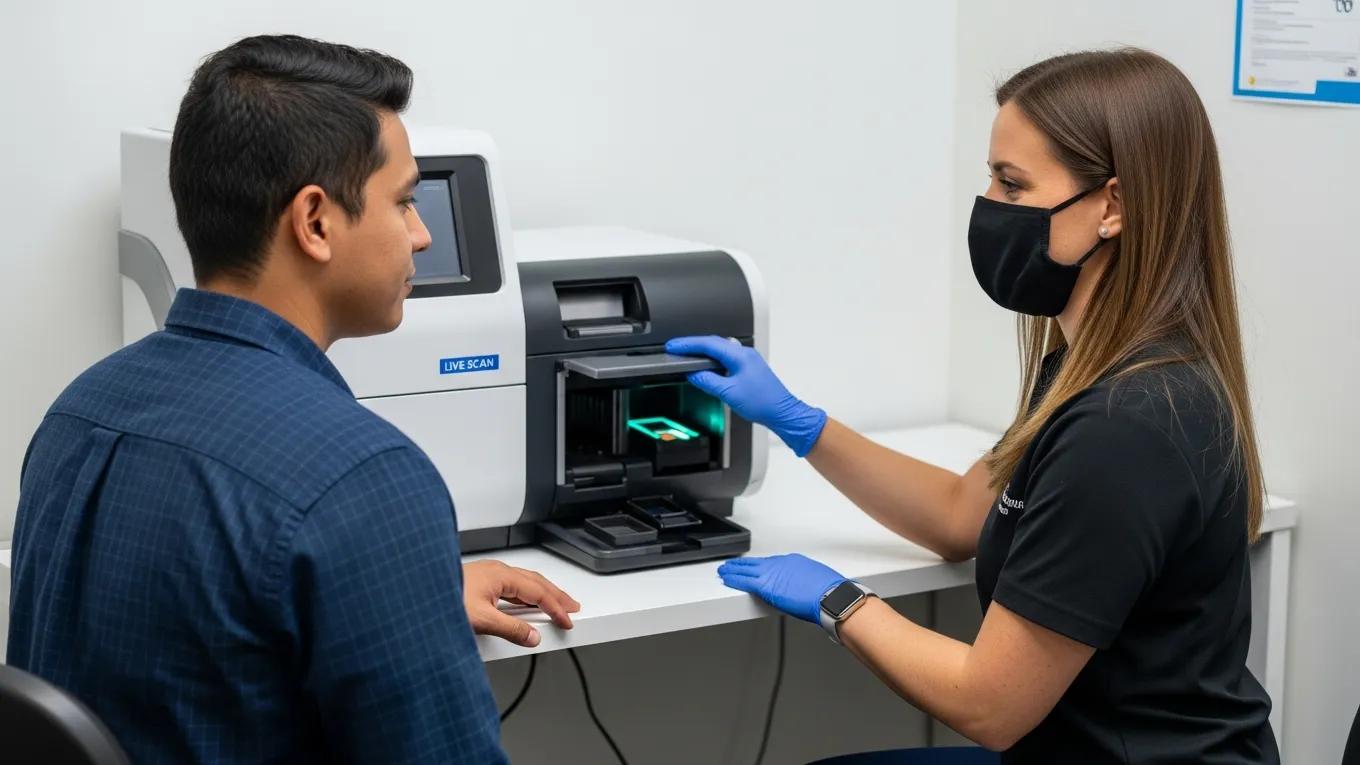
- Get fingerprinted through MR Fingerprints. As an FBI-approved channeler, we capture your Live Scan prints in-person at our downtown Los Angeles location and submit them electronically to the FBI. Standard FBI processing: 6–8 weeks. Expedited options available.
- Receive your FBI Identity History Summary. Issued as a PDF or hard copy. This is your baseline document — it must be dated within 6 months of your Korean consulate appointment date.
- Obtain your US Department of State federal apostille. MR Fingerprints coordinates the federal apostille process on your behalf. Standard apostille: 6–8 weeks. Expedited: 1–2 weeks. Remember: state apostille is not accepted — only the US Department of State Office of Authentications in Washington DC.
- Receive your apostilled FBI document. Delivered to you — original apostilled document, ready to submit to your Korean consulate.
- Submit to your Korean consulate. Book an appointment at the Korean consulate serving your jurisdiction. Bring the complete document package.
| ⏱️ Timing Is Everything for the F-4 Korea Visa The 6-month validity window starts the moment the FBI issues your document — not when you get the apostille. At standard speed, FBI processing (6–8 weeks) + apostille (6–8 weeks) = 12–16 weeks total. That gives you roughly 8–12 weeks of valid window remaining after receiving your apostilled document. Book your Korean consulate appointment BEFORE starting the FBI process so you can time the validity window precisely. Expedited FBI and apostille options can compress the total to 4–6 weeks if your consulate appointment is soon. Contact MR Fingerprints to discuss your timeline before ordering. |
Part 2 — The F4 US Sibling Green Card (Family Fourth Preference)
What Is the F4 Sibling Green Card?
In US immigration law, F4 stands for Family Fourth Preference — the category that allows US citizens who are at least 21 years old to sponsor their brothers and sisters for lawful permanent residence (a green card). The F4 category covers full siblings, half siblings, step-siblings, and adopted siblings, provided the sponsoring US citizen is at least 21.
The F4 sibling green card is one of the most sought-after and most backlogged immigration categories in the entire US system. Because Congress has set annual numerical limits on F4 visas and demand consistently exceeds supply, the wait time from filing to green card approval is measured not in months but in decades.
| ⚠️ F4 Sibling Wait Times as of March 2026 Most countries: 8–17 years from I-130 filing to green card Philippines: 24+ years — the longest backlog in the family preference system Mexico: 13–15 years due to per-country caps India: 10–15 years Despite the wait, filing early is critical — your priority date (the day USCIS receives your I-130) determines your place in line and never changes. Source: March 2026 Visa Bulletin and USCIS processing data |
How FBI Fingerprinting Works for the F4 Sibling Green Card
Unlike the F-4 Korea visa — where you personally obtain and apostille your FBI background check before submitting it to a consulate — the F4 US sibling green card uses USCIS’s own biometrics collection process. You do not need to obtain a separate FBI check or get an apostille. Here is how it works:
- After filing Form I-485 (if your sibling is already in the US on another visa), USCIS automatically schedules a biometrics appointment at a local Application Support Center (ASC). Fingerprints, photo, and signature are collected digitally at the appointment.
- If your sibling is outside the US and processing through consular processing, biometrics are collected at the US Embassy or consulate during the immigration interview process — not at a USCIS ASC.
- In both cases, the FBI background check is run internally by USCIS using the biometrics collected. There is no separate FBI check to obtain, no apostille to coordinate, and no translation required.
- Biometrics results are valid for 15 months. If the application is not adjudicated within 15 months, USCIS will schedule a new biometrics appointment automatically.
The F4 Sibling Green Card Process — Step by Step
| Step | Timeline | Notes |
| File Form I-130 with USCIS | Day 1 | Sets your priority date — file as early as possible |
| I-130 approved by USCIS | 14–18 months | Approval does not mean visa is available — backlog wait begins now |
| Priority date becomes current (Visa Bulletin) | 8–25+ years | Varies by country of origin — Philippines, Mexico, India longest |
| NVC processes case / collects documents | 6–12 months after priority date current | DS-260, I-864 Affidavit of Support, civil documents |
| Sibling completes medical exam | Before interview | At designated civil surgeon |
| Consular interview at US Embassy | Scheduled by NVC | FBI biometrics done at US Embassy abroad |
| Visa approved — sibling enters US | Within 6 months of approval | Enters on immigrant visa — green card mailed after entry |
| Green card received | 2–4 weeks after US entry | Valid 10 years, then renewable |
Total processing times cited above are based on March 2026 Visa Bulletin data and USCIS published processing times. Individual timelines vary by country of birth, service center, and policy environment. Consult an immigration attorney for case-specific guidance.
Key Documents for the F4 Sibling I-130 Petition
While the biometrics appointment is handled automatically by USCIS, the I-130 petition itself requires documentation to prove the sibling relationship:
- Birth certificates for both the petitioning US citizen and the sibling — showing at least one parent in common
- Proof of US citizenship — US passport, naturalization certificate, US birth certificate, or Consular Report of Birth Abroad
- If half-siblings: birth certificates of both siblings showing the shared parent
- If step-siblings: marriage certificate of the shared parent plus birth certificates
- If adopted siblings: adoption decree
- Form I-864 Affidavit of Support — demonstrating the petitioner’s financial ability to support the sibling
- Filing fee: $675 for paper filing, $625 for online filing (as of 2026)
How MR Fingerprints Helps with Both F4 Visa Types
For the F-4 Korea Overseas Korean Visa
MR Fingerprints provides the complete FBI fingerprinting and apostille service required for the F-4 Korea visa application:
- ✅ FBI-approved Live Scan fingerprinting — same-day appointments at our downtown Los Angeles location
- ✅ Electronic submission to the FBI as an FBI-approved channeler
- ✅ US Department of State federal apostille coordination — the only accepted apostille for Korean consulates
- ✅ Expedited options available for tight consulate appointment windows
- ✅ Timeline guidance — we help you time your FBI check within the 6-month validity window
For the F4 US Sibling Green Card
The USCIS biometrics appointment for the I-485 is handled directly by USCIS and cannot be replaced by a private fingerprinting provider. However, MR Fingerprints supports sibling green card applicants in other ways:
- ✅ Re-print services if your USCIS biometrics are rejected due to illegible prints
- ✅ Live Scan fingerprinting for any other immigration-related purposes arising during the long F4 process
- ✅ FD-258 ink card services if any supporting document requires fingerprinting
- ✅ Bilingual staff — Spanish-speaking technicians available for families navigating the process
Frequently Asked Questions
Why does the F-4 Korea visa require a federal apostille but the US sibling green card does not?
The difference comes down to who is processing the background check. For the F-4 Korea visa, you are submitting your FBI document to a foreign government — South Korea — which requires international document authentication under the Hague Apostille Convention. Korea joined the Hague Convention in 2007, so a US federal apostille is the required form of authentication. For the US sibling green card, USCIS is a US federal agency that runs its own background checks internally — there is no need to authenticate a document for a foreign government.
Can I use a state apostille instead of a federal apostille for the F-4 Korea visa?
No — and this is the single most common and most costly mistake Korean-American F-4 applicants make. The FBI Identity History Summary is a federal document issued by a federal agency. It must be apostilled by the US Department of State’s Office of Authentications in Washington DC. A state Secretary of State apostille on an FBI document will be rejected by every Korean consulate without exception. MR Fingerprints coordinates only federal apostilles for the FBI document.
My F-4 Korea consulate appointment is in 8 weeks. Is there enough time?
It is tight but potentially possible with expedited processing. Standard FBI processing is 6–8 weeks and standard apostille is 6–8 weeks — meaning the standard total is 12–16 weeks, which would not fit your timeline. However, with expedited FBI processing (3–4 weeks) and expedited apostille (1–2 weeks), a total of 4–6 weeks is achievable. Contact MR Fingerprints immediately to discuss expedited options for your timeline.
I filed the I-130 for my sibling years ago. Do I need to do anything about fingerprinting now?
Not yet — unless your sibling is in the US and approaching the point where their priority date is becoming current, in which case they should prepare to file the I-485 soon, which will trigger a biometrics appointment automatically. If your sibling is outside the US and processing through NVC and consular processing, the biometrics will be handled at the US Embassy interview. Your priority date determines when those next steps happen — check the monthly Visa Bulletin for your sibling’s country of birth and category.
Does the F-4 Korea visa lead to Korean citizenship?
Not directly. The F-4 visa allows you to live and work in Korea long-term, but it is not a pathway to Korean citizenship by itself. After building sufficient time in Korea on various resident statuses, some F-4 holders may eventually be eligible to apply for Korean permanent residency (F-5) and later citizenship — but this involves separate legal processes, renunciation of other citizenships in some cases, and Korean language requirements. Consult a Korean immigration attorney for guidance on the citizenship pathway.
Can MR Fingerprints help if I am not in Los Angeles?
Yes. For the F-4 Korea visa, if you are not in the Los Angeles area, we offer FD-258 ink fingerprint card services with mail-in kits. However, for the cleanest prints and lowest rejection rates — which is especially important given the 6-month validity window — we recommend visiting our downtown Los Angeles location for Live Scan if at all possible. For the US sibling green card biometrics, your appointment will be scheduled at the USCIS ASC nearest to your address — MR Fingerprints is not involved in that appointment.
Ready to Get Started?
Whether you are a Korean-American applying for the F-4 Overseas Korean visa or a US citizen sponsoring a sibling for a green card, MR Fingerprints is here to help with every fingerprinting step in the process.
? Book your Live Scan appointment for the F-4 Korea visa → https://mrfingerprints.com/book-your-apointment/
? Questions about your timeline or apostille? Contact us → 213.761.5883 | [email protected]