FBI Background Check for Germany: Complete 2026 Guide for US Citizens
Living in Germany as a US citizen — or preparing to move there for work, family, or residency — means you will almost certainly need an FBI background check at some point. Whether it is for your EU Blue Card application, the Niederlassungserlaubnis (permanent residence), German naturalization, or a DoD civilian employment contract, German authorities require US citizens to provide a federally-issued background check with apostille and certified German translation.
This guide covers the full process for 2026: which German visa types require the FBI check, how to get fingerprinted without returning to the US, the apostille and translation requirements, and what makes Germany different from other countries in our network.
Why Germany Requires an FBI Background Check
Germany’s immigration law (Aufenthaltsgesetz) requires proof of a clean criminal record for virtually all long-stay visa and residency applications. For US citizens, this means the FBI Identity History Summary — the only federally-issued criminal record check that covers your entire US history across all states and federal jurisdictions.
A state-level background check — a California DOJ check, a New York state record, or any other state clearance — is not accepted. German authorities specifically require the FBI check because it is comprehensive, federally verified, and fingerprint-based, meaning it cannot be confused with another person’s record.
Germany is also a member of the Hague Apostille Convention, so your FBI document must be authenticated with a federal apostille from the US Department of State. And because German is the official language of administration, a certified German translation is required alongside the apostilled document.
Germany vs. Italy: One Key Difference
| ✅ Germany Accepts a PDF — No Hard Copy Required Italy requires the physical original FBI document with the FBI Section Chief’s wet signature and raised seal. Germany accepts a PDF copy of your FBI Identity History Summary for apostille and submission purposes. This makes the Germany process significantly faster and more practical — you can email us your FBI PDF and we begin processing the same day. No waiting on physical mail. No risk of the original document being lost in transit. |
Which German Visa Types Require an FBI Background Check?
EU Blue Card
Germany’s primary route for highly skilled non-EU workers. In 2026, the salary threshold is €50,700/year for general occupations and €45,934 for shortage occupations including STEM, healthcare, and IT. As of 2025, IT specialists with at least 3 years of relevant experience in the last 7 years can qualify without a university degree. FBI background check with federal apostille and certified German translation required. EU Blue Card holders can apply for permanent residence after 21 months with B1 German, or 27 months with A1.
Skilled Worker Visa (§18a/18b AufenthG)
For qualified professionals with a recognized degree and a specific job offer in Germany. Introduced as part of Germany’s Skilled Workers Immigration Act. A clean criminal record is mandatory — FBI check with apostille and German translation required. Unlike the EU Blue Card, there is no minimum salary but the job must correspond to your qualification.
Freelancer Visa (Freiberufler)
For self-employed professionals including engineers, journalists, IT consultants, artists, doctors, lawyers, and other liberal professions. Applicants must demonstrate sufficient income and that there is demand for their services in Germany. FBI background check required. Note: the Freelancer Visa is distinct from the self-employment visa for commercial businesses — confirm your category with an immigration attorney.
Job Seeker Visa
A 6-month visa allowing qualified professionals to enter Germany and search for employment. No work authorization during the job-seeking period, but the FBI check is required as part of the application. If you find a job and convert to a work visa or Blue Card, your FBI documentation may need to be refreshed depending on timing.
Niederlassungserlaubnis — Permanent Residence
Germany’s permanent settlement permit, granting indefinite residence rights with no expiration. Standard path: 5 years of legal residence plus B1 German, 60 months pension contributions, and a clean criminal record. EU Blue Card holders have an accelerated path: 21 months with B1 German or 27 months with A1. A clean criminal record is an absolute requirement for all permanent residence applications — an apostilled FBI check and certified German translation are standard documentation for US citizens.
German Naturalization
German citizenship requires a minimum of 5 years of legal residence (with reforms in progress that may reduce this to 3 years for exceptional contributions). A clean criminal record, B1 German proficiency, and a civics test (Einbürgerungstest) are all mandatory. FBI documentation required. Germany now allows dual citizenship under recent reforms — US citizens no longer need to renounce American citizenship in most cases.
DoD Civilians and Military Contractors
Germany hosts some of the largest US military installations in Europe — Ramstein Air Base, Stuttgart, Grafenwöhr, Wiesbaden, Spangdahlem, and others. The FBI background check situation for this community is nuanced. Active duty military covered under SOFA have different residency documentation requirements than civilian employees and private contractors. In practice, DoD civilian employees and defense contractors typically need FBI clearance for employment documentation, even when their residency status is covered under SOFA. Security clearance renewals for US citizens stationed in Germany also frequently require updated FBI documentation. Contact MR Fingerprints to discuss your specific situation — we have extensive experience with the German base community.
Family Reunification
Spouses and children of German residents may need FBI documentation depending on their specific circumstances. A1 German language proficiency is required for spousal reunification applications. The sponsor must demonstrate sufficient income and adequate housing. FBI check + apostille + German translation standard for US citizen applicants.
How to Get Fingerprinted From Germany — Step by Step
Step 1 — Contact MR Fingerprints First
Get in touch before doing anything. We confirm requirements for your specific visa type, provide FD-258 fingerprint cards and detailed instructions, and help you plan around your Ausländerbehörde appointment timeline.
Step 2 — Get Fingerprinted in Germany
You have two options from Germany. First, visit a local German police station (Polizeidienststelle) — most can assist with ink fingerprinting on FD-258 cards for foreign official purposes. Call ahead to confirm availability. Second, some notary offices (Notariate) in Germany can assist with fingerprinting for US official documentation. MR Fingerprints will provide FD-258 cards and full instructions before your appointment. Legible, complete prints are critical — smudged cards are the primary reason for FBI rejection.
Step 3 — Scan and Email to MR Fingerprints
Once your fingerprint card is complete, scan at high resolution and email to us. We begin processing the same day. Germany accepts a PDF of the FBI result, so there is no need to mail physical documents — the entire process after fingerprinting is digital.
Step 4 — FBI Processing
As an FBI-approved channeler, we submit your fingerprints electronically to the DOJ in Sacramento. Your FBI Identity History Summary is returned as a PDF. Results in 5–7 business days standard, 48 hours expedited.
Step 5 — Federal Apostille
We prepare your DS-4194 form and submit to the US Department of State Office of Authentications via our DC partner — in person, not by mail. The apostille is processed and returned. Expedited: 7–10 business days (~2 weeks total). Standard: 6–8 weeks. Germany requires the federal apostille — state apostilles are invalid and will be rejected immediately.
Step 6 — Certified German Translation
After the apostille is returned, our certified German translators produce the translation. Delivered alongside your apostilled document as one complete submission-ready package. Ready for your German consulate or Ausländerbehörde submission.
The Translation Requirement — Germany’s Standard
Germany requires a certified German translation of your FBI background check for all immigration submissions. Unlike Italy, the translation requirement for Germany is relatively straightforward:
- Translation must be by a certified (vereidigter) translator — standard requirement across all German immigration authorities
- Translation covers the FBI document text — some Ausländerbehörde offices also request the apostille page to be translated, confirm with your specific office
- Translation is completed after apostille — MR Fingerprints always follows this sequence
- No notarization of the FBI document before submission — do not notarize your FBI check before sending it for apostille
MR Fingerprints provides certified German translation as part of our full-service package. Our translators work directly from the apostilled document and produce translation in the format accepted by German immigration authorities.
EU Blue Card 2026 — Key Updates
Germany’s EU Blue Card program has undergone significant updates that are relevant for US citizens planning a move:
- 2026 salary thresholds: €50,700/year for general occupations, €45,934 for shortage occupations (STEM, healthcare, IT)
- IT specialists without degrees: since late 2023, IT professionals with at least 3 years of relevant experience in the past 7 years can qualify for the Blue Card without a university degree — a major change for the tech community
- Accelerated PR: EU Blue Card holders can apply for permanent residence after 21 months with B1 German (or 27 months with A1) — significantly faster than the standard 5-year path
- Digital portal: Germany launched a fully digital visa processing portal in 2026 — physical original diplomas are no longer required for many categories. FBI documentation requirements remain the same.
- Fast-track procedure: employers and employees can jointly apply for a fast-track procedure that can reduce processing time significantly — the FBI background check is still required and should be prepared in advance
Common Mistakes US Citizens Make for Germany Submissions
- Using a state apostille — any state apostille on an FBI document is invalid. Federal apostille from the US Department of State only. Immediate rejection at every German office.
- Starting too late for the Ausländerbehörde — German immigration offices frequently have appointment wait times of 2–6 months. Your FBI document needs to be issued within 3–6 months of your appointment. If you start fingerprinting after getting your appointment, you may be cutting it close on standard processing. Use expedited if your appointment is within 10 weeks.
- Not getting the German translation — some applicants submit the apostilled FBI document without a German translation and have their application returned. German is the language of administration — translation is always required.
- Going to the US Embassy in Germany — the US Embassy in Berlin and US Consulates in Germany do not provide FBI fingerprinting services. You must use an FBI-approved channeler.
- Submitting a state criminal record instead of the FBI check — California DOJ, Texas DPS, or any state clearance is not accepted. The German authorities specifically require the federal FBI Identity History Summary.
- Assuming SOFA status covers everything for DoD civilians — active duty military have different requirements than civilian employees and contractors. Confirm with your employer and the Ausländerbehörde what documentation is specifically required for your employment category.
Timeline for Germany
- Fingerprinting at German police station or notary: same week in most cases
- FBI processing (standard): 5–7 business days after scan received
- FBI processing (expedited): 48 hours
- Federal apostille (expedited): 7–10 business days (~2 weeks total)
- Federal apostille (standard): 6–8 weeks
- Certified German translation: 3–5 business days after apostille returned
- TOTAL expedited: ~2–3 weeks from fingerprinting to complete package
- TOTAL standard: ~8–10 weeks from fingerprinting to complete package
Germany’s Ausländerbehörde offices can have appointment wait times of several months. Factor this into your planning. If your appointment is within 3 months, use expedited apostille — the additional cost is worth it versus risking a document that expires before your appointment.
How MR Fingerprints Handles the Complete Process
- ✅ Remote fingerprinting — FD-258 cards and instructions for German police stations and notaries
- ✅ FBI-approved channeler — direct submission to DOJ Sacramento
- ✅ 5–7 business days standard, 48 hours expedited
- ✅ Federal apostille only — US Department of State via DC partner, never a state apostille
- ✅ Expedited apostille — ~2 weeks total
- ✅ Certified German translation — delivered with apostilled document
- ✅ All 50 states served — handle Germany submissions nationwide
- ✅ DoD civilian and contractor experience
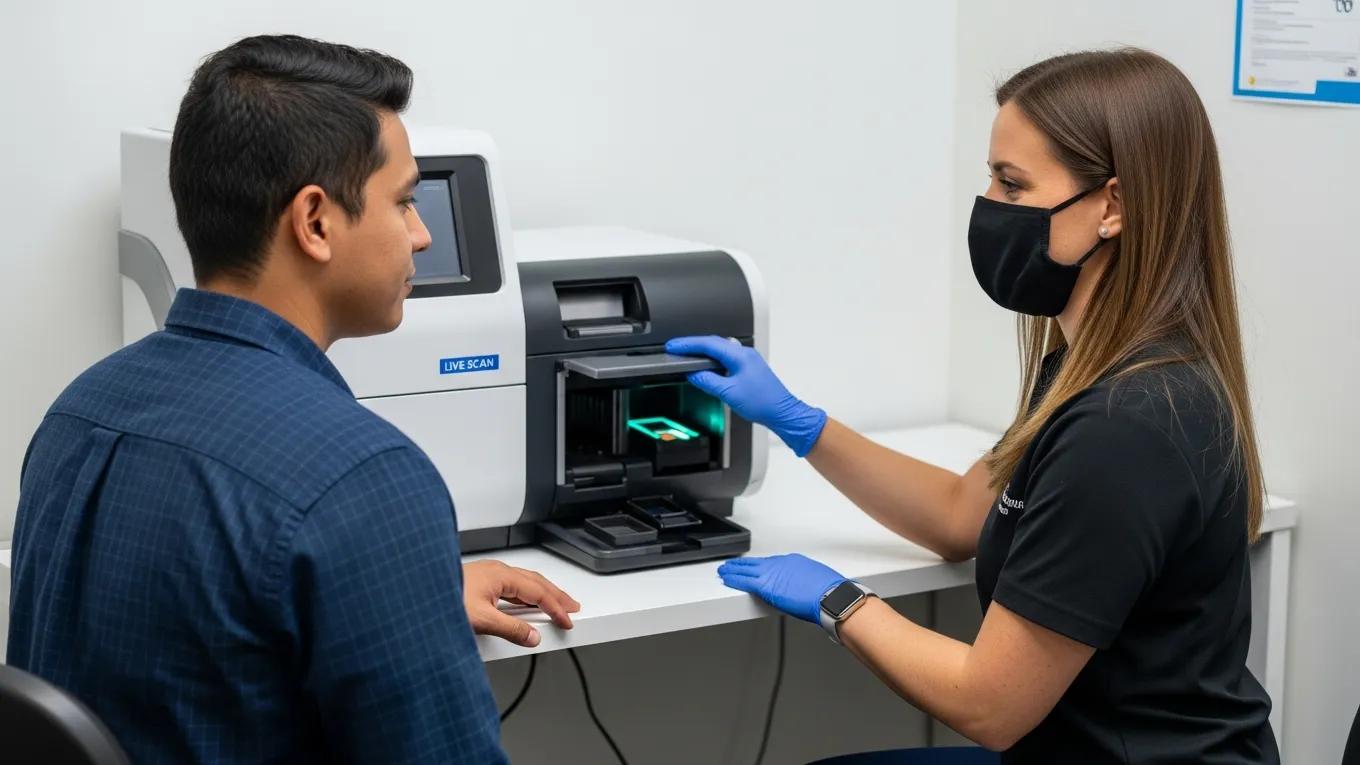
- ✅ In-person Live Scan at downtown Los Angeles for US-based clients
Frequently Asked Questions
I live in Germany — do I need to fly back to the US to get fingerprinted?
No. Visit a local German police station (Polizeidienststelle) and request ink fingerprinting on FD-258 cards for US official purposes. Most stations can assist — call ahead to confirm. MR Fingerprints provides the FD-258 cards and detailed instructions. Scan and email your completed card to us and we handle the FBI submission and apostille.
How long does the Ausländerbehörde take to process permanent residence applications?
Processing for the Niederlassungserlaubnis typically takes 2–6 months from application submission, depending on the office. Getting an appointment in the first place can add another 2–6 months in busy cities like Berlin, Munich, and Hamburg. Factor your FBI documentation timeline into this — you want your apostilled document in hand well before your appointment, not expiring while you wait for a slot.
Does Germany allow dual citizenship now?
Yes — Germany reformed its citizenship law and now allows dual citizenship in most cases, effective 2024. US citizens pursuing German naturalization no longer need to renounce their American citizenship in most circumstances. The FBI background check requirement for naturalization is unchanged.
I applied for my Blue Card from the US — can I still get my FBI check sorted before I arrive?
Yes — and this is the recommended approach. US citizens can enter Germany without a visa and apply at the Ausländerbehörde within 90 days. Completing your FBI fingerprinting and apostille process before arriving in Germany means you arrive with your documentation ready, rather than scrambling after arrival. Contact MR Fingerprints before your move and we will have your complete package ready in 2–3 weeks on expedited.
Ready to Get Started?
MR Fingerprints handles the complete FBI documentation chain for Germany — fingerprinting, FBI submission, federal apostille, and certified German translation. Whether you are applying for an EU Blue Card, Niederlassungserlaubnis, naturalization, or DoD civilian employment, we deliver one complete, submission-ready package.
???? Contact us to get started → [email protected]
???? Message us → Message Us
???? Call us → 213.761.5883