Family-Based Immigration Fingerprinting: 2026 Guide by MR Fingerprints
If you are applying for a green card through a family member — a US citizen spouse, parent, child, or sibling — fingerprinting is one of the first concrete steps you will take after filing your application. It is mandatory, it is federal law, and skipping or missing it can cause your entire application to be delayed or abandoned.
This guide covers everything immigrants and their families need to know about the fingerprinting and biometrics process for family-based immigration and adjustment of status — what it involves, which forms trigger it, what happens to your fingerprints after the appointment, the 15-month validity rule that catches many applicants off guard, and what MR Fingerprints can do to support you throughout the process.
What Is Family-Based Immigration?
Family-based immigration is the process by which US citizens and lawful permanent residents (LPRs) sponsor eligible family members to become lawful permanent residents — green card holders — in the United States. It is the most common pathway to a green card in the US, accounting for the majority of all green cards issued each year.
There are two broad categories:
- Immediate relatives of US citizens — spouses, unmarried children under 21, and parents. These are not subject to annual visa caps, meaning a visa is immediately available once the petition is approved.
- Family preference categories — adult children, married children, and siblings of US citizens, as well as spouses and children of LPRs. These are subject to annual numerical limits and may involve waiting periods based on the Visa Bulletin priority date system.
In both cases, the path to a green card runs through Form I-130 (the immigrant petition) and Form I-485 (the adjustment of status application) — and both trigger mandatory fingerprinting and biometrics collection.
Key Forms in the Family-Based Immigration Process
Understanding which forms are involved helps you understand when and why fingerprinting is required. Here is a reference table for the most common forms in a family-based immigration case:
| Form | Name | Purpose | Who Files |
| I-130 | Petition for Alien Relative | Filed by US citizen or LPR to establish family relationship | Spouse, parent, child, sibling of US citizen |
| I-485 | Application to Register Permanent Residence | The green card application — filed after I-130 approval | All adjustment of status applicants |
| I-765 | Application for Employment Authorization | Work permit while I-485 is pending | I-485 applicants awaiting approval |
| I-131 | Application for Travel Documents | Advance parole — travel while I-485 pending | I-485 applicants who need to travel |
| I-693 | Medical Examination | Civil surgeon exam — filed with I-485 | Required for all I-485 applicants |
| I-864 | Affidavit of Support | Financial sponsor demonstrates ability to support applicant | Family-based petitions |
This table is for general reference only. Immigration cases vary significantly — consult an immigration attorney for advice specific to your situation.
When Is Fingerprinting Required?
Fingerprinting — officially called biometrics collection by USCIS — is required at multiple points in the family-based immigration process:
When You File Form I-485 — Adjustment of Status
The primary fingerprinting trigger in a family-based immigration case is filing Form I-485, the Application to Register Permanent Residence or Adjust Status. After you file your I-485, USCIS automatically schedules you for a biometrics appointment at a local Application Support Center (ASC). You will receive a biometrics appointment notice (Form I-797C) in the mail within approximately 4–8 weeks of filing.
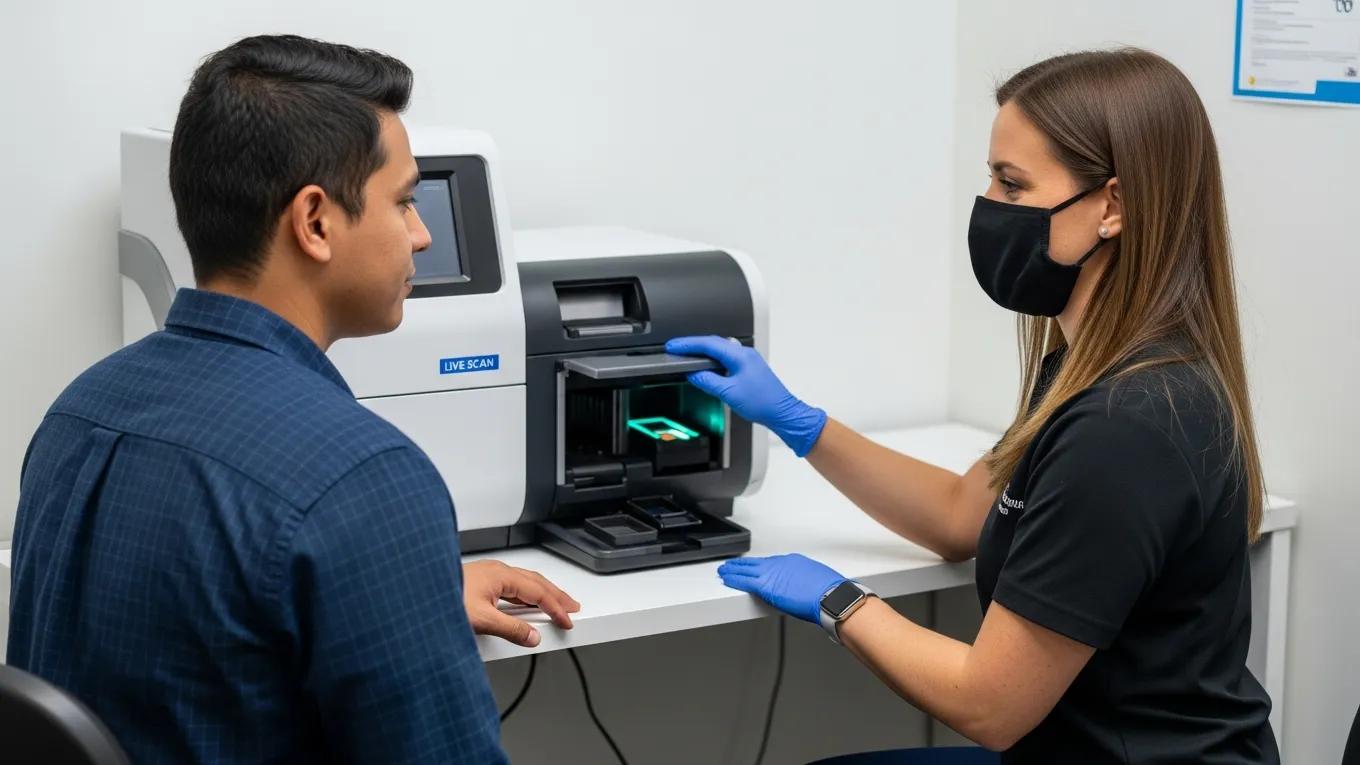
At your ASC appointment, a USCIS officer collects three things: your fingerprints (all ten, electronically via Live Scan), your photograph, and your digital signature. These are used to verify your identity and run a comprehensive FBI background check before your green card application is adjudicated.
When You File Form I-130 — Petition for Alien Relative
In some cases, USCIS may also require biometrics from the petitioner (the US citizen or LPR filing the I-130) as part of the petition process. This is more common when USCIS needs to verify the petitioner’s identity or conduct additional screening. If required, you will receive a separate biometrics appointment notice.
At Renewal or Re-Fingerprinting
FBI background check results obtained through biometrics collection are valid for 15 months. If your adjustment of status application is not completed within 15 months of your biometrics appointment — which can happen in cases with long processing times or requests for evidence — USCIS will require you to be re-fingerprinted before your application can be adjudicated. This is one of the most commonly overlooked details in the process.
| ? The 15-Month Rule — What Most Applicants Don’t Know FBI background check results from your biometrics appointment are only valid for 15 months. If your I-485 is not approved within that window — due to processing backlogs, RFEs, or interview delays — USCIS will require new biometrics before they can approve your case. You will not need to refile your I-485 — USCIS will simply schedule a new biometrics appointment. However, if you are approaching the 15-month mark without hearing about your interview, contact USCIS proactively. This rule applies equally to spouses, children, and all other family-based applicants. |
Step-by-Step: The Fingerprinting Process for Family-Based Immigration
- File Form I-130 with USCIS. The US citizen or LPR petitioner files Form I-130 to establish the qualifying family relationship. For immediate relatives of US citizens, the I-130 can be filed concurrently with the I-485. For preference category relatives, you must wait for the I-130 to be approved and a visa to become available before filing the I-485.
- File Form I-485 when a visa is available. Once your priority date is current per the Visa Bulletin (or immediately for immediate relatives), file Form I-485 with the required supporting documents, medical exam (Form I-693), and Affidavit of Support (Form I-864). You may file Form I-765 (work permit) and Form I-131 (advance parole) concurrently.
- Receive your biometrics appointment notice. Within 4–8 weeks of filing your I-485, USCIS will mail you a biometrics appointment notice (Form I-797C) with the date, time, and location of your ASC appointment. Do not miss this notice — it is mailed to the address on your application.
- Attend your ASC biometrics appointment. Bring your appointment notice and a valid government-issued photo ID. The appointment takes 15–30 minutes. Your fingerprints, photograph, and signature are collected electronically. You cannot reschedule without contacting USCIS in advance.
- FBI background check is processed. Your fingerprints are transmitted to the FBI within 24–48 hours of your appointment. The FBI checks them against its national criminal history database. Results are returned to USCIS within approximately 30 days. USCIS will not approve your I-485 until the FBI background check clears.
- USCIS schedules your interview (if required). For most family-based cases, USCIS requires an in-person interview at a local USCIS field office. You and the petitioning family member will both be asked to attend. The interview verifies the bona fides of your family relationship and your eligibility for the green card.
- Green card approved and mailed. If your interview goes well and USCIS approves your I-485, your green card will be mailed to your address within 2–4 weeks of the approval decision.
Realistic Timeline for Family-Based Adjustment of Status
| Step | Typical Timeline |
| File Form I-130 with USCIS | 1–12 months depending on category |
| I-130 approved — visa becomes available | Immediate relatives: immediate. Preference categories: varies by Visa Bulletin |
| File Form I-485 (and I-765, I-131 if needed) | File as soon as visa is available |
| Receive biometrics appointment notice (Form I-797C) | 4–8 weeks after I-485 filing |
| Attend ASC biometrics appointment | 15–30 minute appointment |
| FBI background check processed | ~30 days after biometrics |
| USCIS interview scheduled (if required) | Varies — 6–24 months after filing depending on field office |
| Green card approved and mailed | 2–4 weeks after interview or approval decision |
Timelines vary significantly by USCIS field office, visa category, and individual case circumstances. Immediate relatives of US citizens generally have the fastest processing times. Preference category cases depend heavily on visa availability per the monthly Visa Bulletin.
What to Bring to Your Biometrics Appointment
- Your biometrics appointment notice (Form I-797C) — the original
- A valid government-issued photo ID — green card (if you have one), passport, state driver’s license, or state ID
- Any additional documents specified on your appointment notice
Do not bring children, food, or guests into the ASC fingerprinting area. Most centers have limited waiting room space.
Fingerprinting Exceptions for Minors and Medical Conditions
Children Under 14
Children under 14 are generally exempt from fingerprint collection at their biometrics appointment, but are still required to attend for photograph and signature collection. The biometrics appointment notice will specify what is required for each applicant.
Applicants with Medical Conditions Affecting Fingerprints
If you have a medical condition that affects your fingerprint ridge detail — such as worn fingerprints from manual labor, skin conditions, or chemotherapy-related changes — inform the USCIS officer at the start of your appointment. The officer may attempt multiple captures or use alternative methods. If prints cannot be obtained after multiple attempts, USCIS may proceed with alternative identity verification. MR Fingerprints can assist with pre-appointment practice prints if you are concerned about print quality.
Applicants Outside the United States
If you are applying for an immigrant visa through consular processing (rather than adjustment of status), biometrics collection takes place at the US Embassy or consulate handling your visa interview abroad, not at a USCIS ASC. Consular processing follows a different sequence — your immigration attorney can advise on the specific requirements for your consulate.
Re-fingerprinting After Rejection
If the FBI cannot read your fingerprints — due to smudging, insufficient ridge detail, or incomplete captures — USCIS will notify you and schedule a second appointment. This does not affect your application status, but it does add time. MR Fingerprints provides Live Scan fingerprinting services that produce near-zero rejection rates, and re-print services on FD-258 ink cards for any application requiring physical cards.
How MR Fingerprints Supports Immigrant Families
MR Fingerprints works with immigrants and their families throughout the Los Angeles area, providing fast, accurate fingerprinting services that support every step of the family-based immigration process:
- ✅ FBI-approved Live Scan fingerprinting — same-day appointments available in downtown Los Angeles
- ✅ FD-258 ink fingerprint cards — for any application requiring physical fingerprint cards
- ✅ Re-print services — if your USCIS biometrics were rejected or prints were returned as unreadable
- ✅ Mobile fingerprinting — for families or groups needing fingerprinting at a specific location
- ✅ Bilingual staff — Spanish-speaking technicians available for your family members
- ✅ Immigration law firm referrals — we work with immigration attorneys across Los Angeles; contact us to discuss referral arrangements
While MR Fingerprints does not replace your mandatory USCIS ASC appointment — that appointment is set by USCIS and must be attended as scheduled — we can support you at every other fingerprinting touchpoint in your immigration journey.
Frequently Asked Questions
Does MR Fingerprints replace my USCIS biometrics appointment?
No. Your USCIS ASC biometrics appointment is mandatory and set by USCIS — it cannot be replaced by a private fingerprinting provider. However, MR Fingerprints provides fingerprinting for other immigration-related purposes, re-print services if your USCIS prints were rejected, and Live Scan and ink card services for applications beyond the I-485.
Can I reschedule my USCIS biometrics appointment?
Yes — USCIS allows rescheduling for valid reasons such as medical emergencies or documented conflicts. Contact USCIS at 800-375-5283 before your scheduled appointment date to request a reschedule. Do not simply miss the appointment — a no-show without prior contact can result in USCIS considering your I-485 abandoned and issuing a denial.
How long after the biometrics appointment will I hear about my interview?
Processing times vary significantly by USCIS field office and visa category. After your biometrics appointment, some applicants receive interview notices within a few months; others wait a year or more, particularly in high-volume field offices like Los Angeles. You can check your case status at uscis.gov/tools/case-status-online. If your case has been pending longer than the published processing time, you may submit a case inquiry through the USCIS website.
What if my green card application takes longer than 15 months?
If your I-485 remains pending more than 15 months after your biometrics appointment, your FBI background check results expire. USCIS will automatically schedule you for a new biometrics appointment — you do not need to file anything new or pay an additional fee. Simply attend the new appointment when notified. This is more common than many applicants expect, particularly in preference category cases with long processing times.
Do all family members need separate biometrics appointments?
Yes. Each individual applicant filing their own Form I-485 — including derivative beneficiaries such as spouses and children filing concurrently — will receive their own separate biometrics appointment notice. Family members cannot share a single biometrics appointment or attend each other’s appointments. Each person must attend individually at the time specified on their own notice.
Is fingerprinting required for a marriage-based green card?
Yes. A marriage-based green card application goes through the adjustment of status process via Form I-485, which automatically triggers a biometrics appointment for the applicant. In most cases, the US citizen spouse who filed the I-130 petition may also be required to attend a biometrics appointment. Both spouses are typically required to attend the I-485 interview together at the USCIS field office.
What happens at the USCIS interview for a family-based green card?
The USCIS interview for a family-based green card — particularly marriage-based cases — tests the bona fides of the family relationship. An officer will ask both the petitioner and the applicant questions about their relationship, living situation, and shared life. You will be asked to bring original documents submitted with your application. Approval at the interview typically leads to green card approval; the card is then mailed within 2–4 weeks. If the officer has concerns, they may issue a Request for Evidence or schedule a second interview.
Ready to Get Started?
Whether you are at the beginning of your family immigration journey or somewhere in the middle, MR Fingerprints is here to support you. We provide fast, accurate Live Scan and ink card fingerprinting services from our downtown Los Angeles location, with bilingual staff and same-day appointments available.
For immigration law firms handling family-based cases in the Los Angeles area, we offer quick turnaround and reliable results for your clients. Contact us to discuss a referral arrangement.
? Book your fingerprinting appointment → https://mrfingerprints.com/book-your-apointment/
? Contact us → 213.761.5883 | [email protected]